
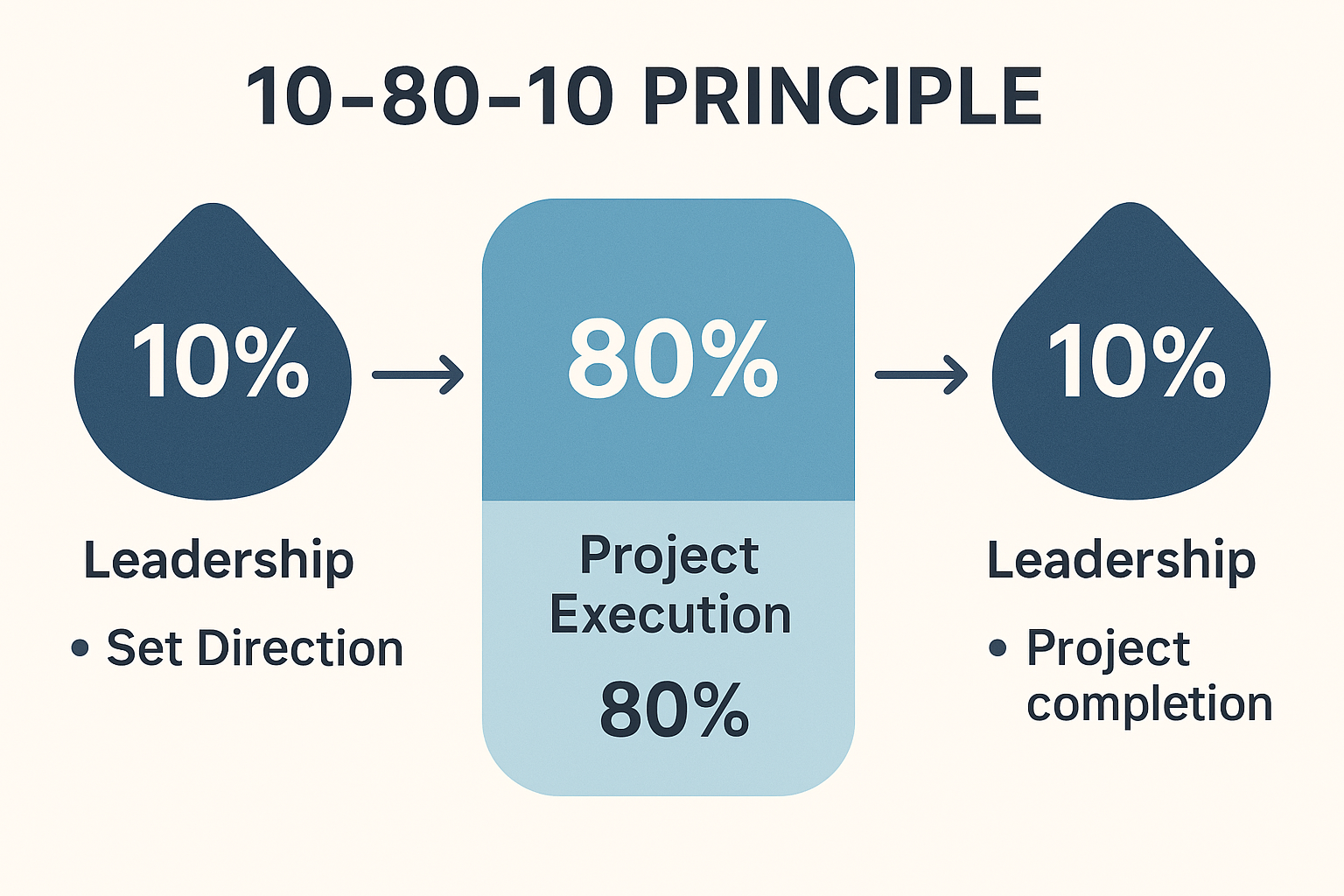
Digital transformation projects often fail not because of technology, but because of leadership engagement, too much too late, or too little too soon. After working with multiple transformation programs, I’ve come to rely on what I call the 10-80-10 Rule: a leadership rhythm that ensures alignment, empowerment, and continuity from concept to completion.
The 10-80-10 Rule Explained
The First 10% : Setting the Vision and Direction
In the opening phase of a transformation project, leadership must lead from the front.
Roughly 10% of the total project effort should be heavily weighted toward senior involvement, defining the “why” through clear goals, moulding the project’s purpose, and articulating a vision that the entire team can rally behind.
This stage aligns with Kotter’s first steps of transformation:
- Create a sense of urgency –-> communicate why now matters.
- Build a guiding coalition –-> identify the champions and key influencers.
- Form a strategic vision and initiatives –-> define the narrative and outcomes.
Without this leadership scaffolding, teams risk running profitably, but in the wrong direction.
The Middle 80% : Empowering the Experts
Once the direction is set, leadership must step back and empower the experts.
During this long “delivery” phase, the Pareto principle applies:
- 80% of the work is done by delivery teams, technical experts, developers, and analysts;
- 20% is ongoing oversight, progress checks, KPI reviews, stakeholder updates, and removing structural barriers.
This balance ensures that while leaders stay connected, they don’t suffocate innovation. It’s in this space that empowerment drives momentum.
Kotter’s middle steps resonate strongly here:
4. Enlist a volunteer army –-> give people ownership and autonomy.
5. Enable action by removing barriers –-> eliminate friction.
6. Generate short-term wins –> celebrate measurable progress.
This is where trust meets traction.
The Final 10% : Re-engaging Leadership for Impact
As the project nears completion, leadership must return to the forefront to reconnect the transformation’s outcomes with the organisation’s strategy and mission.
Again, Pareto applies, 80% focus from leaders, 20% from project execution to:
- Seal alignment with the original vision.
- Communicate the impact across the business.
- Integrate the change into culture and operations.
Here, Kotter’s final steps come to life:
7. Sustain acceleration –-> consolidate gains and build on success.
8. Institute change –-> make the transformation part of “how we work.”
This closing phase ensures that transformation outcomes are not just delivered, but anchored in leadership priorities.
Why the 10-80-10 Rule Works
- It maintains leadership engagement throughout, without micromanagement.
- It aligns execution with strategic objectives, preventing “project drift.”
- It nurtures accountability and trust, empowering teams while ensuring oversight.
- It creates continuity,so the vision set at the beginning is reinforced at the end.
In essence, the 10-80-10 Rule keeps digital transformation strategic, empowered, and sustainable, a loop where leadership influence is strongest at the moments it matters most.
Final Thought
Digital transformation demands both visionary leadership and deep technical execution. The success of the journey lies in balancing oversight and empowerment.
The 10-80-10 Rule isn’t just a formula, it’s a mindset. One that ensures leaders ignite the project, empower the experts, and then return to embed the change as part of their organisation’s future. Within digital healthcare we see the Office of the CIO as the scaffolding that ensures successful 10-80-10 delivery of digital transformation within the NHS.