Every week I see another post declaring:
“AI will never replace developers.”
“AI can’t replace healthcare scientists.”
“AI can’t replace clinical engineers.”
They’re both right and wrong.
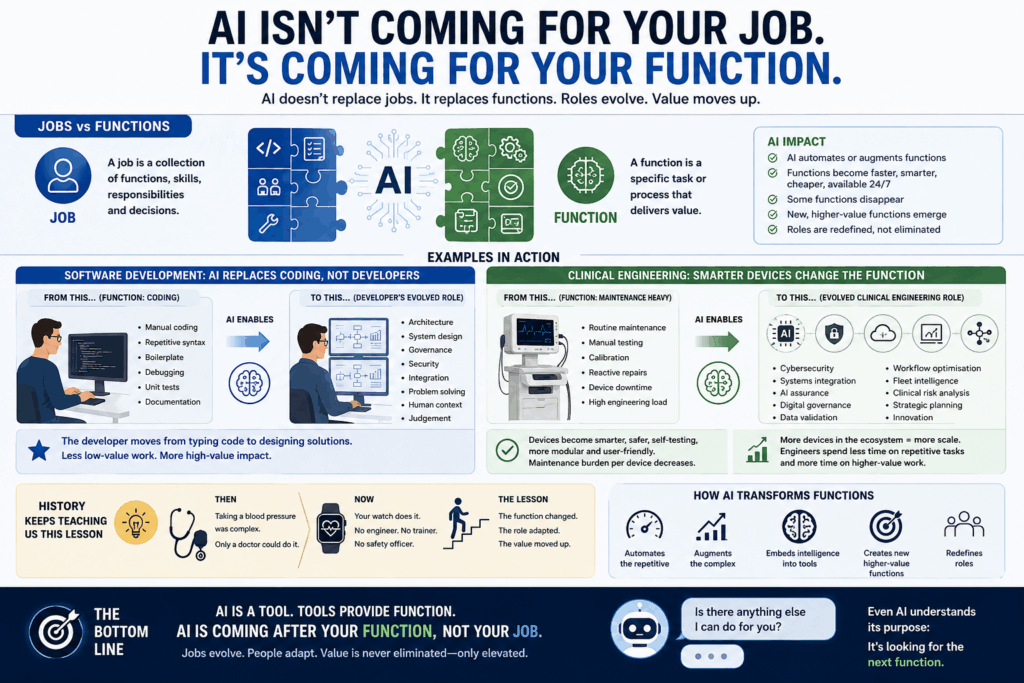
Because AI doesn’t replace jobs.
It replaces functions.
That distinction matters.
Take software development.
Vibe coding isn’t replacing developers.
It’s replacing coding.
The inefficient, repetitive, syntax-heavy function of manually constructing software is being abstracted away. The role of the developer doesn’t disappear — it evolves upward.
Architecture.
Governance.
Safety.
Systems thinking.
Human understanding.
Context.
Integration.
Judgement.
The developer becomes less of a typist and more of a conductor.
The same applies in healthcare.
I often see claims that AI cannot replace the healthcare scientist or the clinical engineer.
Again, correct.
But also incomplete.
AI-enabled medical devices are already changing the functional landscape:
Devices becoming self-testing.
Devices becoming more modular.
Predictive fault analysis.
Automated calibration validation.
Improved usability.
Reduced manufacturing waste through user-swappable components.
Safer operation through embedded intelligence.
This doesn’t eliminate Clinical Engineering.
It changes what Clinical Engineering does.
Historically, maintaining devices consumed enormous amounts of engineering effort because the devices themselves were relatively “dumb.”
Smarter devices reduce maintenance burden.
But smarter devices also increase scale.
If devices become safer, easier to maintain, more automated, and more self-aware, healthcare organisations will deploy more of them, not fewer.
Which means engineers spend less time performing repetitive functional maintenance and more time on:
Cybersecurity.
Systems integration.
AI assurance.
Digital governance.
Data validation.
Workflow optimisation.
Fleet intelligence.
Clinical risk analysis.
And those functions will also become increasingly AI-assisted.
History keeps teaching us this lesson.
There was a time when taking a blood pressure reading was considered so technically complex and clinically sensitive that only a doctor could perform it.
Now?
Your watch does it.
No clinical engineer nearby.
No trainer.
No medical device safety officer.
No calibration specialist standing beside you.
The function changed.
The role adapted.
This is what many people misunderstand about AI.
AI is not simply automation.
It is functional abstraction.
The task itself becomes embedded into the tool.
And that is why debates around “AI replacing jobs” often miss the point entirely.
Jobs are collections of functions.
AI disassembles those functions one by one.
Some disappear.
Some evolve.
Some become supervision tasks.
Some become governance tasks.
Some become human-only trust tasks.
But the role itself survives by moving upward.
The irony is visible every time we use AI.
At the end of the conversation it asks:
“Is there anything else I can help you with?”
Even AI understands its purpose.
It is searching for the next function.