May 2026
Everyone is talking about vibe coding as if we already understand where it leads. The dominant narrative is simple, almost comforting: AI will get better, it will write more of our code, and eventually it will write all of it. Developers become supervisors, copilots become autopilots, and the rest is just iteration.
But that framing misses the deeper shift entirely.
The real question isn’t whether AI will replace developers. It’s whether code itself remains the interface between humans and machines.
Today, even the most advanced AI still produces code in languages designed for us, Python, TypeScript, Go. These languages are human artefacts. They are full of ambiguity, stylistic preference, implicit context, and historical baggage. They work because humans can interpret them, debate them, and maintain them over time.
AI doesn’t need any of that.
As models improve, the inefficiency becomes obvious. Why force a machine to express logic in a format optimised for human readability, only for another machine to interpret it again? It’s a translation layer we’ve taken for granted, but it won’t survive optimisation pressure forever.
So the evolution of vibe coding is not about AI mastering our languages. It’s about moving beyond them.
What replaces code isn’t a new, cryptic, AI-only language. That would collapse under its own weight, impossible to audit, impossible to govern, impossible to secure in any meaningful way. In regulated environments especially, unreadable systems aren’t innovative, they’re unusable.
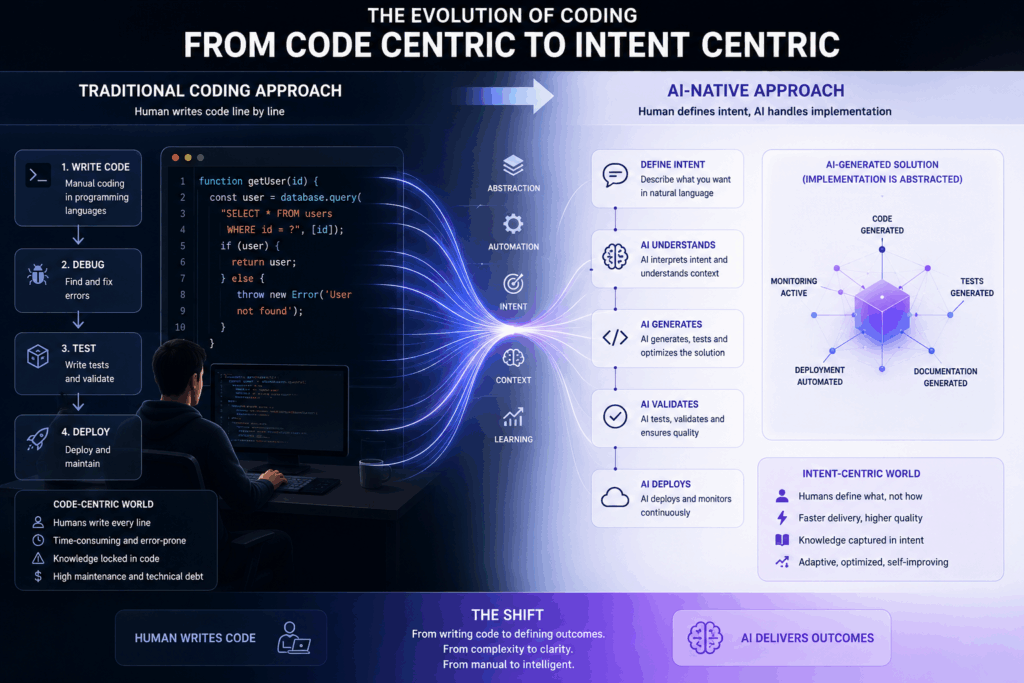
Instead, we are heading toward something more abstract and more disruptive: a world where developers stop writing code altogether and start defining intent.
In that world, the primary artefact is no longer the implementation. It is the specification. We describe what must be true, what constraints must hold, what outcomes are acceptable, and what policies cannot be violated. The AI takes those declarations and continuously generates whatever implementation is required in the moment, code that may never be read by a human, and may not even persist beyond its execution.
Code, in other words, becomes a transient byproduct rather than the core asset.
This is where the conversation becomes uncomfortable.
Because as abstraction increases, understanding does not scale with it. We are moving toward systems that are not just complex, but post-legible, systems where no single human, or even team, can fully trace the path from intent to execution. Behaviour is no longer verified purely through logic and inspection, but through statistical validation, simulation, and continuous testing against defined constraints.
We don’t read the system. We observe it.
And that raises questions most organisations are not prepared to answer.
If code is no longer the stable artefact, where does governance live? If systems are constantly regenerating, what exactly are you auditing? What does “secure by design” mean when the design itself is fluid? And perhaps most critically, who is accountable when no human explicitly authored the logic that led to an outcome?
These are not edge cases. In sectors like healthcare, finance, and public infrastructure, they are existential concerns.
What emerges from this shift is a new kind of engineering discipline. The valuable skill is no longer the ability to implement logic in a given language. It is the ability to define truth with precision, to express intent, constraints, and boundaries in a way that a machine cannot misinterpret.
This is harder than coding. It requires clarity of thought, domain understanding, and a much tighter coupling between technology and real-world outcomes.
So while the industry debates whether AI will write all our code, the more important transformation is already underway.
We are not just automating programming.
We are removing code as the primary interface altogether.
And the organisations that recognise this early won’t just build faster.
They will think differently about what software actually is.