
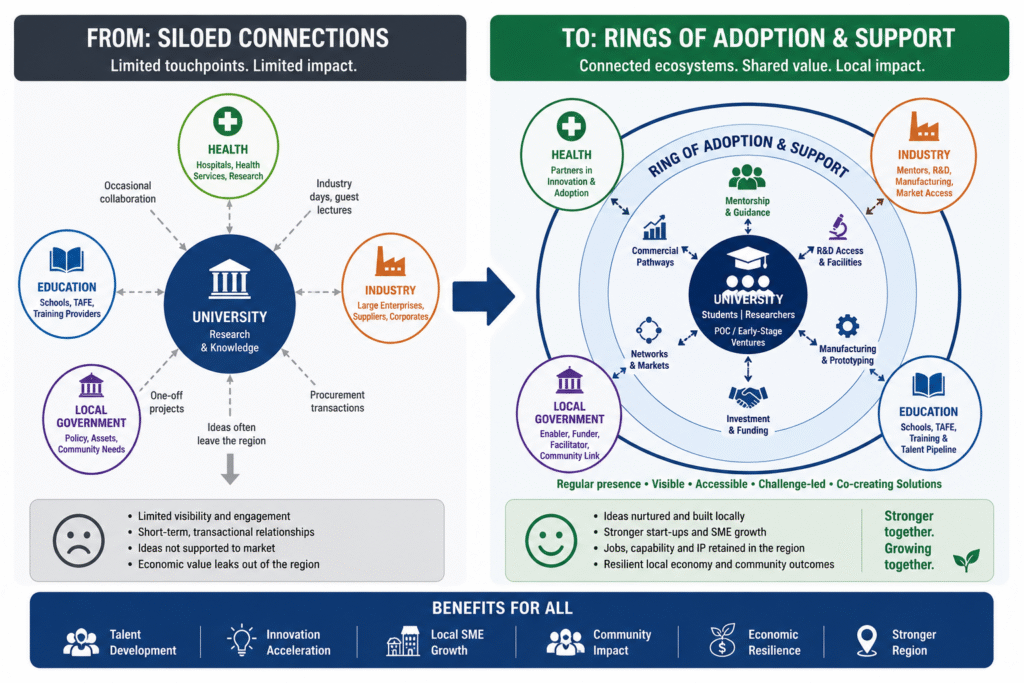
Universities have become very good at encouraging innovation, start-ups, and proof-of-concept projects. What many regions still struggle with is turning those ideas into sustainable local economic growth.
What if we built a stronger “adoption ring” around local entrepreneurs?
Imagine university students and researchers developing early-stage companies, but instead of being left to navigate alone, they are supported by established local businesses willing to mentor, share R&D capability, provide manufacturing access, offer operational guidance, and help them scale safely.
Large organisations already collaborate with universities, but too often the long-term economic value leaks out of the region. The start-up gets acquired elsewhere, manufacturing moves overseas, or talent relocates to larger cities.
A local ecosystem model could change that.
Experienced companies become safe havens for emerging SMEs. New entrepreneurs gain access to real-world experience, governance, infrastructure, supply chains, and commercial knowledge that would otherwise take years to build. In return, established businesses gain innovation pipelines, fresh thinking, future partnerships, and stronger regional resilience.
Visibility matters. Innovation ecosystems are not built through occasional guest lectures, annual industry days, or one-off networking events. The real value comes from consistent physical presence and accessibility. Students and early-stage entrepreneurs need regular exposure to experienced companies, engineers, designers, manufacturers, and business leaders during the very moment ideas are forming. Challenge-led learning becomes far more powerful when the challenge owners themselves are visible, engaged, and available for ongoing discussion, mentoring, and collaboration. This is more than just a few hot desks in the corner, it is managed collision spaces. Key is the balance of value, universities cannot ask industry to come support students without offering something of value back to the companies. Opening more opportunity for companies to attend lectures, set assignments and be present at student presentations.
It is in those informal conversations, problem-solving sessions, and repeated interactions that ideas mature into viable opportunities. Presence creates trust, trust creates confidence, and confidence gives people permission to build.
This is not charity. It is strategic local investment.
Government support could play a major role here. Tax incentives, innovation funding, procurement advantages, and recognition programmes for organisations actively mentoring and developing local SMEs could help create self-sustaining regional innovation ecosystems.
If we want stronger local economies, we cannot just fund innovation. We must also fund the structures that help innovation survive long enough to become part of the local economy.
Real economic growth happens when collaboration becomes infrastructure.
As a mentorship company, having helped companies as far a field as India, we think all companies should be able to find a bit of time to help someone that is in a place we all were at some point.